
Table of Contents
- The Real Numbers: What sort of returns will you see?
- Buying Property in Dubai Pros and Cons
- Is It Safe to Invest in Dubai Real Estate? Regulatory Protections
- Dubai vs. Major Global Cities: Investment Comparison
- 7 Critical Mistakes That Increase Property Risk
- Betting on Unverified Developer Track Records
- Selecting Unit Types That Do Not Reflect Actual Demand
- Neglecting Turnkey Furnishing & Interior Presentation
- Ignoring the Long-Term Impact of Mollak Service Charges
- Neglecting a Cash Liquidity Buffer
- Overlooking Secondary Market Exit Liquidity
- Skipping Independent Property Snagging Before Handover
- In Conclusion: Is Buying Property in Dubai a Good Investment?
- FAQs
Are you making an investment when the bubble is too close to the top, and your investment is stranded?
Is buying property in Dubai a good investment, or just a sales pitch? You will find every social media broker telling you they are offering 10% guaranteed returns, passive income without hassle- how do you choose? You might have a fear of being caught out on an off-plan project that gets delayed, of high service charges for the building that might take your profit margin to the wire, or of an apartment being difficult to resell is real. You could be investing hundreds of thousands of dollars into a foreign investment market without understanding the ground reality.
According to official numbers from the Dubai Land Department (DLD) and studies from international corporations such as Knight Frank and CBRE, Dubai’s residential market has evolved from a short-term investment, speculative economy to a user-driven, cash-backed one.
We can see the numbers still look good, as total gross rental yields, which are in the range of 6% to 8% in Dubai and significantly above those obtainable in London, New York or Singapore at 2 to 4%, remain attractive. But ultimately, this is about the numbers and knowing the math, choosing the right location and then understanding the real operational costs.
When asking yourself, should I buy property in Dubai, here is the answer that shows when you should buy, and when you should not buy Property in Dubai.
I will go through these, including the precise figures, regulations, and compromises, so you can confidently decide whether is buying property in Dubai a good investment for your personal financial goals.
The Real Numbers: What sort of returns will you see?
Is buying property in Dubai a good investment on yield alone? If you want to determine whether an investment is appropriate, you must isolate the gross yields from your marketing pamphlets from the actual net cash flow into your bank account.
- Gross Yields: Apartments in popular communities such as Jumeirah Village Circle (JVC), Business Bay and Dubai Marina can easily achieve 6.5- 8% gross rental yields.
- Net Yields: Returns, after maintenance & building service charges (RUDA regulated under RERA Mollak system), property management fee most often between 5 to 8% of rent, and minimal repair provision, on average net out at around 4.5% to 6%.
While lower than headline marketing claims, a 5% net cash yield in a tax-free market backed by a USD-pegged currency (AED) still easily outperforms most global real estate capitals.
According to a market report by Gulf News surrounding CBRE real estate audits, tenant demand has shifted toward well-connected, community-driven master plans. While capital values in prime segments have established a higher floor, average gross yields of 6% to 7% on apartments continue to cushion investors against global inflation, providing steady cash yields that outstrip traditional mature capitals.
Buying Property in Dubai Pros and Cons
Seeing the pros and cons gives you a realistic, balanced perspective before making the transfer.
Pros
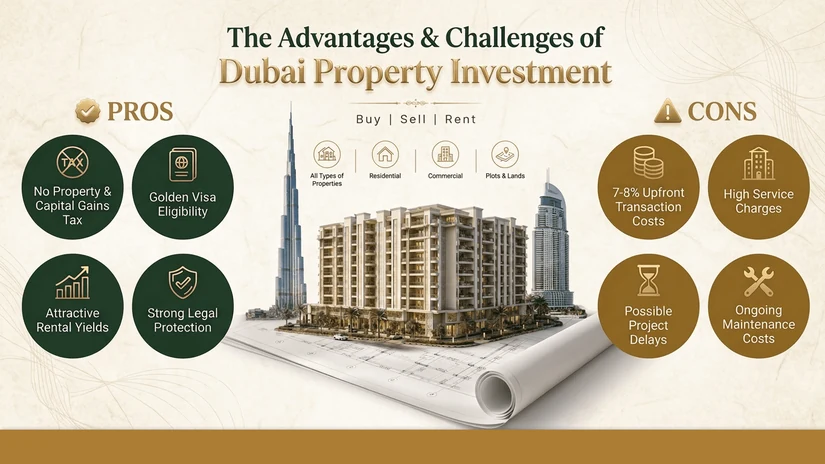
- No direct property & capital gains tax: There is no tax on personal income, yearly property council tax, or capital gains tax related to the real estate property. Upon acquiring the property, a single transfer tax of 4% is payable to the Dubai Land Department.
- Purchasing a completed or suitable off-plan property at a value of AED 2,000,000 or higher for yourself and your immediate family, you are eligible to submit an application for a 10-year renewable residency visa.
- The master communities at a prime distance which are well-developed with metro accessibility are a demanded due to expat professionals and moving in families. Exploring trending luxury interior design styles 2026 allows owners to understand the spatial aesthetics, premium finishes, and modern layouts that command the highest leasing demand in these prime zones.
- All off-plan projects are enrolled in Dubai’s Investor-Friendly Law No.8 of 2007, with dedicated registered escrow accounts to hold investor funds only against the actual physical completion of each stage of construction.
Cons
- Upfront Transaction Friction: Expect about 7% to 8% above the property price to go toward transfer and agency commissions and trustee fees.
- A number of towers with high-end amenities charge AED 20 to AED 50+ per sq. ft. per year. That expensive luxury 1,200 sq. ft. apartment may set you back AED 30,000 a year in service charges to cool your heels, and it might cost even more to keep the pools brimming.
- There is a lot of documentation for the developer to settle at handover, so delays of 6 to 12 months do occasionally occur.
Understanding these considerations is a must when reviewing buying property in Dubai pros and cons for your portfolio.
Is It Safe to Invest in Dubai Real Estate? Regulatory Protections
Is buying property in Dubai a good investment from a legal point of view? A common question among new international buyers is: Is it safe to invest in Dubai real estate? Over the last decade, the Government of Dubai restructured its legal landscape to protect foreign capital:
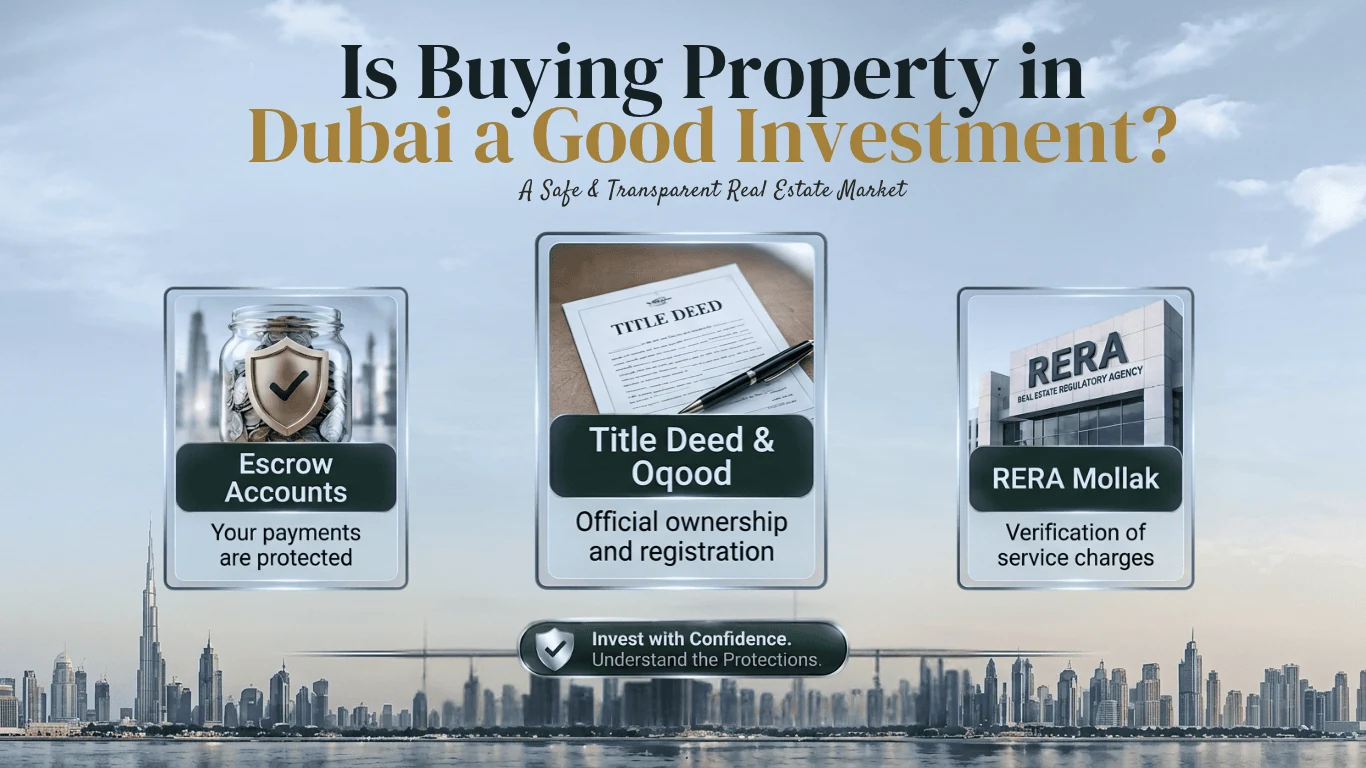
1. Mandatory Escrow Accounts: Developers cannot access your money for other projects. Every dirham paid toward an off-plan home stays in a dedicated account monitored by the DLD and is only released as building phases pass official inspection.
2. Title Deeds and Oqood Registration: Every sale is registered digitally on the DLD’s REST system. Secondary purchases receive an instant Title Deed, while off-plan contracts get an official pre-registration certificate (Oqood).
3. Service charges are not arbitrarily set by the owner of the building; they are submitted, examined, and certified by RERA each year.
Therefore, the mentioned structural rules are one of the reasons why I believe Dubai is making itself one of the most transparent real estate markets in the Middle East.
According to investigative coverage by The National on consumer tenancy protections, regulatory integration through the DLD’s smart rental index and new tenancy payment frameworks has sharply reduced landlord-tenant payment disputes, creating an institutional-grade investment environment that shields foreign capital from unexpected litigation.
Dubai vs. Major Global Cities: Investment Comparison
| City | Average Gross Rental Yield | Property / Capital Gains Tax | Currency Stability | Foreign Ownership |
|---|---|---|---|---|
| Dubai | 6.0% to 8.0% | 0% | Pegged to USD (AED) | 100% Freehold in designated zones |
| London | 3.0% to 4.5% | Stamp Duty + Capital Gains | Subject to GBP volatility | Freehold & Leasehold restrictions |
| New York | 2.5% to 4.0% | State, Local & Federal Taxes | USD baseline | Subject to co-op board approvals |
| Singapore | 2.5% to 3.5% | Up to 60% Additional Buyer Stamp Duty | SGD baseline | Heavy foreign buyer restrictions |
Is buying property in Dubai a good investment next to London or New York? When looking at global yield tables, many international investors ask: is it worth buying property in Dubai compared to mature Western markets? The answer comes down to risk management.
7 Critical Mistakes That Increase Property Risk
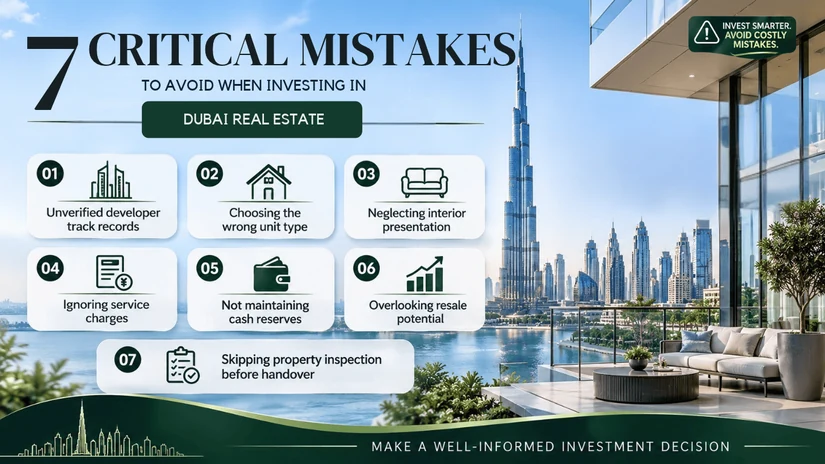
Is buying property in Dubai a good investment if you make these mistakes? To protect your returns, you must actively address property risk on every transaction and steer clear of common operational missteps:
1. Betting on Unverified Developer Track Records
Do not buy off-plan solely on marketing renders and glossy launch events. Check the developer’s delivery history on the official Dubai REST app or the DLD Project Status portal.
Look at whether their past phases finished on schedule, examine escrow compliance under Law No. 8 of 2007, and inspect the build quality of their completed communities before committing capital.
2. Selecting Unit Types That Do Not Reflect Actual Demand
Luxurious super-high-end penthouses and innovative Unit types offer visual appeal; however, they demand longer vacancy duration. Units that are smaller with fewer beds, especially studios and 1-bedroom units in adjacent master neighbourhoods, like JVC, Dubai South and Business Bay, experience much quicker turnover and may keep occupancy high. Choose the right Unit type based on the residents who live here to help maximise your returns.
3. Neglecting Turnkey Furnishing & Interior Presentation
Whatever your cash flow plan, whether it’s renting to long-term corporate or executive tenants, or short-term, high-yield vacation homes, the presentation of the interior will determine your real net yield. Unfurnished or poorly presented apartments will stay on the market longer and attract lower rents. Furnished, well-equipped apartments always draw 15% to 25% higher rents.
Knowing how to choose an interior design agency confirms you have the right people handling Dubai building permits, DM permits and fit-out schedules.
4. Ignoring the Long-Term Impact of Mollak Service Charges
A typical mistake is to compare yields on purchase price alone, not accounting for ongoing building service charge payments. Never sign any contract until you have received a recently updated rate sheet of Mollak-approved service charges from the seller or building management.
An apartment that looks affordable on an AED 35 to AED 55sqft annual service charge for maintenance will soon prove to be a flop.
5. Neglecting a Cash Liquidity Buffer
Is buying property in Dubai a good investment without a cash buffer? Real estate is not a liquid bank account. Buying a property with every last dirham of your savings leaves you vulnerable to sudden special levies, minor tenancy turnover gaps, or tenant maintenance claims.
Maintaining a dedicated reserve of three to six months’ worth of mortgage payments and service charges ensures you never face forced liquidation during seasonal market pauses.
6. Overlooking Secondary Market Exit Liquidity
Most buyers start a deal thinking solely about How do I buy, with no strategy for How do I sell, ever. Buying one-of-a-kind, highly customised units, and irregularly shaped layouts in far-flung projects dramatically diminish your future investor base.
1-2 bedroom units near public transport, main arterial roads ( Sheikh Zayed / Al Khail) and shopping amenities will maintain excellent resale liquidity year-round.
7. Skipping Independent Property Snagging Before Handover
Believing a newly completed handover or clean resale property stands defect-free is a costly gamble. Undetected MEP issues, unbalanced AC ducted airflow, minor balcony waterproofing leaks, and low-quality grouting can amount to thousands of dirhams in rectification costs after the transfer window or developer liability period ends.
Verifying the key qualities of an interior design agency , such as rigorous site oversight, snagging audits, and transparent material billing ensures potential architectural flaws are caught and rectified early.
In Conclusion: Is Buying Property in Dubai a Good Investment?
When looking closely at cash flow, tax efficiency, and long-term capital preservation, is it worth buying property in Dubai?
Yes, if you apply a disciplined property investing approach rather than expecting a get-rich-quick project. Taking an analytical, numbers-driven approach proves why is buying property in Dubai a good investment for foreign investors seeking long-term diversification.
Is buying property in Dubai a good investment for the long run? Investors who select high-traffic suburban centers, allow for recurrent building costs, and use cautious net yield projections regularly generate passive income.
Adopting a considered, analytical, numbers-driven methodology proves why buying property in Dubai is a good investment for foreign investors looking to diversify away from high-volatility equities.
Turning an unfinished home into a profitable luxury rental requires well-thought-out layouts, turnkey fit-outs and long-lasting finishes. Enlisting the help of a top interior design agency can help you create functional yet impressive interiors that meet the high standards of international corporate tenants and optimise the value of your asset.
Contact us Today to talk about your future project and start planning your interior renovation.
FAQs
1. Are foreigners allowed to own 100% of a property in Dubai?
Yes. The 2002 Freehold Law allows foreign nationals to own, sell, lease, and inherit freehold property entirely in certain freehold investment zones such as Dubai Marina, Downtown, Palm Jumeirah and JVC.
2. Is buying property in Dubai a good investment for passive income?
Yes. Since rental earnings on personal properties are not subject to tax, an investor in a residential unit contributes a much bigger portion of their net rental gain than rental income in the North American or European market.
3. What is the minimum investment required for a Dubai Golden Visa?
The minimum property purchase amount to meet this criterion is AED 2,000,000. This can be a single property or numerous properties, purchased through cash or approved local mortgage financing.
