
Table of Contents
- Why Snagging Defects in Dubai Matter Before Your Interior Design Starts
- 5 Common Snagging Defects in Dubai Handovers
- Major vs Cosmetic: Which Snagging Defects in Dubai to Push Hardest?
- Developer or Interior Design Agency: Who Fixes What?
- How an Interior Design Agency Handles Defects Before Execution
- Protect Your Fit-Out from Snagging Defects in Dubai
- FAQs
- What are the most common snagging defects in Dubai new builds?
- What should I do if the developer hasn’t fixed my snags by handover?
- Which snagging defects are major and which are just cosmetic?
- Should I do a second snagging inspection before the defects liability period ends?
- Can an interior design agency handle snagging defects for me?
You finally walk into your new apartment in Downtown or your villa in Dubai Hills. The marble lobby downstairs smells like luxury, and holding that physical access card feels like the ultimate win.
Then you step inside, close the front door and take a closer look.
You notice the baseboard doesn’t sit flush against the drywall. There’s an uneven, hollow tap beneath your feet when you step across the porcelain tile. The AC vent in the master bedroom gives off a faint whistling hum that doesn’t sound right.
You might think you will just mark the scratches and let maintenance sort it out.
Don’t sign that handover slip too early. Snagging defects in Dubai are easy to miss on day one and expensive to fix once your fit-out starts.
While researching this topic, I went through the concerns homeowners posted on Reddit and Quora, and many of them had problems with snagging defects in Dubai. Their biggest fear is investing hundreds of thousands of dirhams in bespoke joinery, imported stone and custom lighting, only to see it ruined eight months later because a developer issue was left unresolved.
Read on to discover the five most expensive handover mistakes, what to look for during property handover, how to make your developer fix the problems and how an interior design agency protects your investment before a single hammer swings.
Why Snagging Defects in Dubai Matter Before Your Interior Design Starts
Think of fixing snagging defects in Dubai as insurance for your finishes. If you mount custom wardrobes over a damp wall or an unlevelled screed, you will eventually have to rip them down to fix the root cause.
Once the bespoke joinery, book-matched marble slabs, wall panelling and acoustic ceilings are in place, you can no longer check the baseline condition of the property. If a hidden chilled-water pipe has a tiny pinhole leak, or a bathroom floor slab doesn’t fall correctly towards the drain, the defect will slowly rot your bespoke walnut veneer from the inside out.
5 Common Snagging Defects in Dubai Handovers
When developers rush to meet tight deadlines, subcontractors cut corners and the same errors show up every single time. Bringing in one of the top interior design agencies early can save you from a future disaster. Here are the five common property snagging errors found during initial handovers.
1. Hollow Tiles and Uneven Floors
What It Looks Like: Walk into the living room and tap the centre and corners of the large-format porcelain tiles with an inspection stick. If you hear a high-pitched, drum-like echo, run a digital laser level across the room and you will often find dips and crests beyond standard construction tolerances.
Why Developers Leave It: Tilers working under compressed handover deadlines often use spot-bonding, dotting five dabs of adhesive on the corners and centre instead of combing adhesive evenly across the whole surface with a notched trowel.
According to tile installation standards published by the Tile Council of North America (TCNA), tiles in dry interior areas need at least 80% mortar coverage, and tiles in wet areas need 95%. In a rushed handover, spot-bonded tiles can fall far short of that.
What Goes Wrong If You Design Over It: If you install heavy, floor-to-ceiling media units, glass partitions, or imported hardwood over hollow tiles, point-load stress will crack the porcelain.
How an Interior Design Agency Fixes It
An interior design agency fixes it with acoustic and laser level mapping. Before drafting fit-out drawings, the team runs a tap test across every square metre and maps the floor with self-levelling cross-line lasers. If you are still comparing firms, read our guide to choosing an interior design agency.
2. Wall Cracks, Patchy Paint, and Uneven Plaster
What It Looks Like: Walls look fine in flat daylight, but switch on a wall-wash fixture or check the corridor at night under downlights and the surface looks like a wrinkled shirt: visible plaster trowel ridges, roller stippling and fine zigzag cracks along the drywall joints.
Why Developers Leave It: Summer construction brings high humidity, fast curing of concrete and micro-settling. Subcontractors paint the walls in natural daylight with contract-grade emulsion, and instead of refinishing the entire wall, painters apply local feather-edged patches that dry to a different texture and sheen.
What Goes Wrong If You Design Over It: Luxury finishes such as wallpaper, acoustic panelling, linear LED grazing lights and flush shadow-gap skirting show every flaw. If a wall is out of plumb by 8 mm, hidden door frames won’t line up with the panelling.
How an Interior Design Agency Fixes It
The team inspects wall surfaces at night or in dark rooms with high-lumen grazing lights to reveal substrate defects that normal inspections miss.
They push the developer to open up settlement cracks, apply fibreglass reinforcing tape and skim the wall corner to corner instead of doing patchy touch-ups.
3. Leaks, Poor Sealant, and Low Water Pressure
What It Looks Like: Check the lower aluminium tracks of sliding balcony doors, the space beneath vanity sinks and the ceiling access panels. You may spot peeling silicone, calcium stains along pipe joints and water pressure that drops to a trickle when two fixtures run at once.
Why Developers Leave It: Standard silicone sealants break down fast in the UAE’s coastal heat and UV when external-grade structural silicone isn’t used. In plumbing systems, the balancing valves on water distribution manifolds are often left uncalibrated.
What Goes Wrong If You Design Over It: Dr Joseph Lstiburek of the Building Science Corporation, a recognised authority on building enclosures, has written about inward vapour drive: in hot, humid climates, cooled interiors pull moisture from the outside in.
When external sealants fail:
- Humid outside air bypasses the building envelope.
- It collides with interior surfaces cooled to 21°C.
- Hidden condensation and mold breed behind your new wall paneling.
- Minor leaks swell marine-ply cabinetry within months, ruining custom stonework.
How an Interior Design Agency Fixes It
An interior design agency can use FLIR thermal imaging cameras to scan exterior walls, window tracks and plumbing chases for active leaks and thermal bridges before any materials arrive on site.
They also check static and dynamic water pressure at every outlet so your specified rain showers and thermostatic mixers work properly. If they find moisture, the developer must re-seal the exterior glazing and replace the damp drywall. Once moisture meter readings fall within the safe range for each material, they clear the site for fit-out.
4. Electrical Faults and AC That Underperforms
What It Looks Like: You set your smart thermostat to 20°C, but the room stays at 25°C on a hot summer afternoon. A multimeter test shows ungrounded or mis-wired outlets, and the bathroom exhaust fans drone loudly without pulling enough air out.
Why Developers Leave It: AC fan coil units (FCUs) are often clogged with debris from the construction clean-up, condensate drain lines are poorly sloped and volume control dampers are left unbalanced.
What Goes Wrong If You Design Over It: If you finish your home in one of the luxury interior design styles without fixing these systems first, you inherit long-term comfort and safety problems:
- An underperforming FCU creates persistent drafts and noisy air distribution.
- Unchecked condensate trays overflow, staining expensive drop ceilings.
- Standard socket layouts force you to run extension cords across the floor, breaking the clean aesthetic of bespoke furnishings.
How an Interior Design Agency Fixes It
They measure airflow and the supply versus return air temperature difference across every FCU with calibrated anemometers to confirm proper cooling, and they audit every circuit for continuity, earthing and breaker loads.
5. Chipped Joinery, Scratched Stone, and Faulty Doors
What It Looks Like: Standard doors scrape the floor, bathroom marble countertops carry scratch marks from tools and belts, and the laminate edges of wardrobes are chipped and then coloured over with wax for a quick fix.
Why Developers Leave It: In the last rushed weeks before handover, hundreds of trade workers pass through each unit. Damage happens, and quick cosmetic patches with wax or touch-up markers help the property pass inspections and the first buyer walkthrough.
What Goes Wrong If You Design Over It: Homeowners waste weeks arguing with developer teams to repair low-grade, mass-produced wardrobes or synthetic marble vanity tops they secretly plan to replace anyway. Meanwhile, the real issues, like sagging fire-rated entrance doors or out-of-square door casings, get ignored.
How an Interior Design Agency Fixes It
They review developer defects against your project’s scope of work. If the design replaces standard hollow-core doors with custom floor-to-ceiling pivot doors, they won’t waste your time arguing over a chipped veneer.
Major vs Cosmetic: Which Snagging Defects in Dubai to Push Hardest?
The most common question I see from new owners on Reddit is simple: “The developer gave me a two-week window to report defects, but the list has 120 items. What do I actually fight for?”
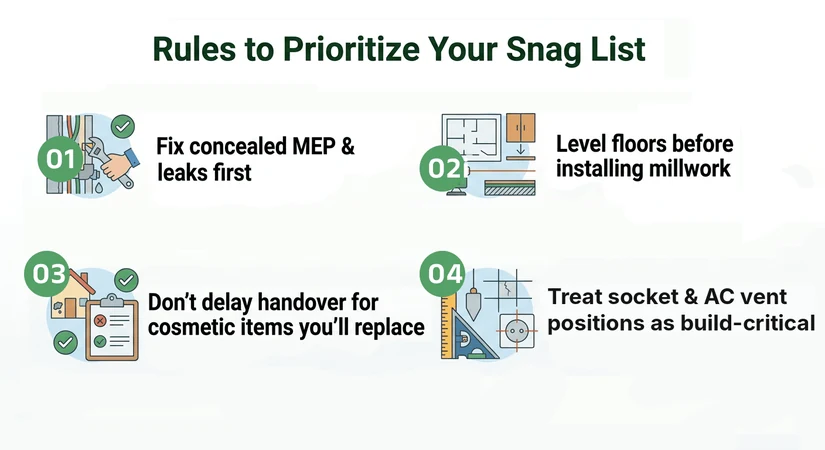
Here is a simple way to sort common property snagging errors and fix them in the right order:
| Priority | Defect Examples | Why It Matters |
|---|---|---|
| Push Hard (Developer must fix) | Concealed leaks, AC duct condensation, dead circuits, weak water pressure, deep structural cracks, window frame drafts/leaks | These are expensive, worsen fast, and will be inaccessible once your fit-out begins. |
| Fix Before Fit-Out (Site team must align) | Hollow floor tiles, uneven sub-floor screed, out-of-plumb walls, misaligned AC vents & socket heights | Anything built directly on top (bespoke joinery, large-format slabs, wall cladding) inherits the slope and fails. |
| Often Cosmetic (Secondary priority) | Minor paint scuffs, chipped stock skirting, light scratches on builder-grade counter tops, dusty AC grills | Always log them on paper, but don’t halt your handover schedule if your interior design will demo or replace them anyway. |
Developer or Interior Design Agency: Who Fixes What?
The most frequent complaint I hear from homeowners on Reddit is: “I put in 40 snags four months ago. It’s handover tomorrow, and nothing has been done.”
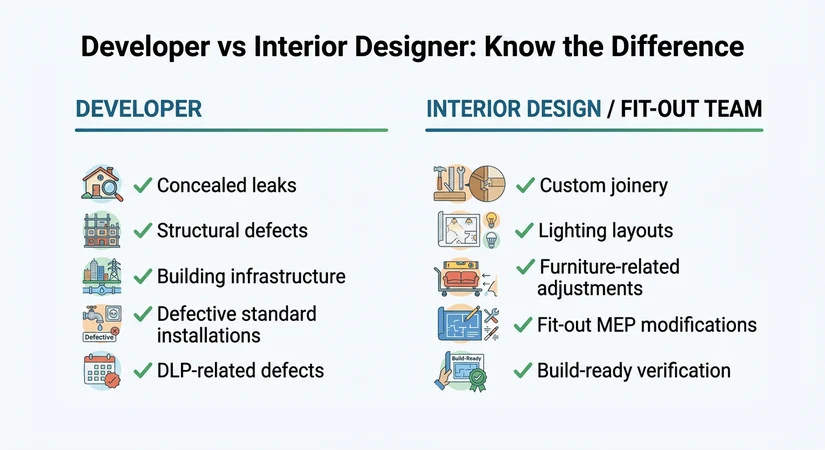
The last thing you want is to be stuck in a loop. To avoid handover snagging mistakes, you need solid evidence and a clear escalation process.
1. Don’t Sign a Clean Handover
The developer will push you to sign a form stating the condition of your property. Don’t sign it as it is. Write this on the line above your signature:
“Accepted subject to the attached snagging report dated [DD/MM/YYYY]”.
2. Create a Paper Trail Through Your SPA
Skip the quick WhatsApp messages to site engineers. Email the developer’s registered customer care team with dated, high-resolution photos.
Check the defect clause in your Sales and Purchase Agreement (SPA).
Major structural defects that threaten a building’s stability fall under a 10-year liability period in UAE Civil Code Article 880.
3. Run a Two-Stage Snagging Plan
Don’t inspect just once. Here is what to look for during property handover and again before your warranty runs out:
Stage 1 (at handover): Catch obvious MEP, plumbing and finishing defects before you move in.
Stage 2 (month 9 or 10): Run a second inspection just before the usual one-year defects liability period (DLP) ends. Some hidden leaks, faulty valves and AC insulation failures only show up after a Dubai summer.
4. Escalate Through Official Dubai Channels
If the developer stonewalls on critical defects:
- File a formal complaint with the Dubai Land Department (DLD).
- For shared building issues (lifts, corridors, pools), raise them with your owners’ association and building management. Service charges and association records sit in the DLD’s Mollak system.
How an Interior Design Agency Handles Defects Before Execution
Bringing in a design team before handover helps you avoid common handover snagging mistakes and turns a stressful fight with your developer into a coordinated fix.
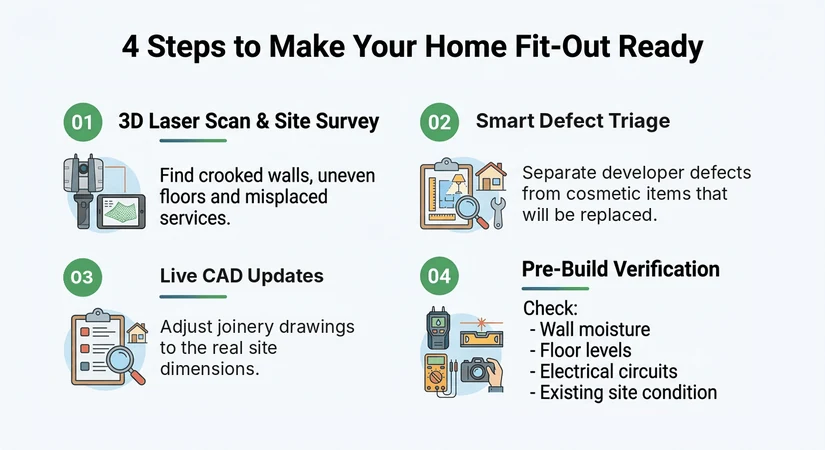
An interior design agency uses 3D laser scanning to find crooked walls before anyone starts building. It uses smart defect triage to hold the developer accountable for hidden infrastructure issues, while ignoring cosmetic flaws in areas you already plan to remodel. And if a concrete pillar is slightly off, the team updates the custom joinery CAD drawings so your project never stalls.
Protect Your Fit-Out from Snagging Defects in Dubai
Getting the keys to your new Dubai property is exciting, but there is a right and a wrong way to deal with snagging defects in Dubai. If you ignore hollow tiles, substrate cracks, moisture, underperforming AC and damaged joinery, your fit-out will suffer and cost more to fix later.
Get ahead of the problem. By inspecting your site early, separating cosmetic issues from important MEP ones and fixing the base before building, you make every dirham count.
We take care of your time, budget and peace of mind.
Reach out to us to book a pre-site survey and luxury design consultation.
FAQs
What are the most common snagging defects in Dubai new builds?
The most frequent snagging defects in Dubai include hollow floor tiles, uneven wall plaster, hairline settlement cracks, leaking AC condensate lines, poorly balanced cooling systems, low water pressure and damaged joinery finishes. They come from compressed construction timelines and overlapping trades working to meet handover deadlines.
What should I do if the developer hasn’t fixed my snags by handover?
Never sign an unconditional handover release. Accept the keys only after writing “Subject to rectification of attached snag list” on the handover form. Submit the report formally via registered email, cite the DLP clause in your SPA, and escalate unaddressed structural or MEP defects to the Dubai Land Department.
Which snagging defects are major and which are just cosmetic?
Major defects involve MEP functionality, thermal performance and water integrity: leaking pipes, AC cooling failures, ungrounded circuits and structural cracks. Cosmetic defects include minor paint scuffs, scratched cabinet doors and dusty AC grills, which are often replaced anyway if you plan an interior renovation.
Should I do a second snagging inspection before the defects liability period ends?
Yes. You should schedule a secondary inspection 9 to 10 months after handover. Certain latent defects, such as condensation within drywall assemblies, failing AC components, and plumbing leaks, only surface after the mechanical systems run under real-world household loads across Dubai’s summer climate.
Can an interior design agency handle snagging defects for me?
Yes. An interior design agency audits the space against both construction standards and your proposed layout. They triage defects, direct developer rectification efforts toward critical items, and adapt technical joinery and MEP drawings so the fit-out proceeds smoothly without costly on-site delays.
